The Beauty of Almost
Imperfection as the condition of existence
"Well! I've often seen a cat without a grin," thought Alice;
"but a grin without a cat! It's the most curious thing I ever saw in my life!"
Lewis Carroll, “Alice’s Adventures in Wonderland”, 1865
Six days a week Murphy's bar was a bar like any other, but Thursdays were different. On Thursdays Murphy's hosted a singles' party, and that party was legendary. By eight o'clock the line curled halfway down the block, and inside the air hummed with that particular flirtatious electricity of people pretending to come for a drink. No wonder locals jokingly called the party “Big Bang”.
The party had a strict door policy with just two rules. The first: only one hundred men and one hundred women were allowed to enter. The second: the dress code for the party was black and white. Murphy, the owner, stood at the door with her clicker, bouncer and bookkeeper in one, enforcing them. Click — a man. Click — a woman. A simple rule. Click. Click. Click. Two hundred times. Perfect order.
At half past eight I turned around and saw a guy sitting at the bar wearing a bright Hawaiian shirt. I was stunned: he had managed to break both rules at once: he wasn't on the list and he wasn’t dressed appropriately. An explosion of color in otherwise monochrome surroundings. He caught me staring, raised his glass and nodded: “Barry.” “How did you get in here?” He just winked at me, smiled mysteriously, and raised his glass again.
One would think this was no big deal. An uninvited guest to a singles’ dating event. One hundred and one men. One hundred women. One extra loose item within an otherwise symmetrical arrangement... how much could it matter?
Now, step back from the bar... A little further... a bit more... Then step back by many orders of magnitude in size and in time. The same party took place fourteen billion years ago, except the name was no longer a joke.
In the first microsecond after the Big Bang everything arrived in equal numbers, pair by pair. Matter and antimatter appeared in pairs: for every quark, its antiquark; for every electron, its positron. Click — a particle. Click — an antiparticle. The Universe itself stood at the door with a clicker. This early speed dating was run very efficiently; the particles wasted no time on small talk. When a matching pair of matter and antimatter encountered each other, they annihilated, leaving only light behind.
Barry and his Hawaiian shirt managed to crash that party as well. His presence also broke the rule of perfect symmetry, with one small difference: the scale. In Murphy’s bar the ratio was skewed by 1%: one hundred women versus one hundred and one men. In the early Universe that ratio differed by seven orders of magnitude: one billion antimatter particles versus one billion and one particles of matter. One extra matter particle per billion pairs — a drop of water in a swimming pool. That tiny misalignment was enough to challenge the perfect balance, to break the absolute symmetry, and to set a chain reaction in motion.
Perfection, as a state, appears to be extremely fragile. It’s like having an infinitely sharp pencil balancing on its tip. Theoretically it can maintain that balance. Practically speaking though, that balance is extremely unstable, a single gas molecule bouncing off the pensil could make it fall. It’s like standing on top of a mountain, any step in any direction leads downhill. Maintaining that state requires an immense amount of energy to counterbalance all forces affecting you.
Consequently, nature does not allow such states. Absolute zero is unattainable by definition: no matter how much you cool, an irreducible quantum tremor remains in matter — the zero-point motion, a last skew that cannot be taken away. The perfect vacuum — ideal emptiness — is not empty: it seethes with particle pairs being born and vanishing. Wherever you look, the handwriting is the same: perfect is forbidden, only almost is permitted.
A minor imperfection, a tiny skewness, appears to be the signature trait of the universe, reincarnating itself in different forms in every dimension. In the accounting ledger of particles, it shows up as a slight skew towards matter. In the fabric of space, it takes the form of microscopic quantum fluctuations, so tiny they are barely measurable. And yet it makes a difference. Shortly after the Big Bang those fluctuations started interacting with other particles, gradually involving more and more of them in the process. The growing volatility began affecting the trajectories of other elementary particles. Different trajectories created islands of uneven density in the otherwise uniform distribution of matter.
Tiny gravitational forces created by that uneven density started bending the space-time continuum. This made more matter to slide into the bent regions, setting the snowball in motion. That was the birth of the first material structure.
As time progressed and the Universe cooled, atomic structures could form. Eventually gravity pulled them into stars, where nuclear fusion produced heavier elements. When those stars exploded as supernovae, they scattered the produced elements across space, creating the building blocks for planets, complex molecules, and eventually life.
According to the standard model of cosmology, our universe is on a journey from initial singularity to heat death. The initial singularity is a state of almost perfect order. The word almost is very important. Had the initial universe been completely uniform or isotropic in every direction, it would have been in complete equilibrium without force imbalances. The subatomic particles would not start interacting with each other, as they would already have been in an energy-minimizing, stable state.
Imagine a world without differences: same temperature, same density, same energy. Such world is governed by indistinguishability. Going in any direction with any speed doesn’t change anything, the surroundings stay the same. Nothing can happen in such world, the very word “happen” loses its meaning. Without differences, no gradient; without gradient, no flow; without flow, no events. Without events there is no time. A perfect order of a perfect universe would have stayed absolutely perfect until today. Perfect but sterile. Perfect but dead.
For any structure to be created, it required a crack in that pristine order. The crack was Barry, the uninvited guest. Everything you see around you is made of one billionth of the survivors of primordial battle between matter and antimatter. Everything is made of Barry and his Hawaiian shirt. Every galaxy. Every planet. Every living thing. You, yourself.
A Symphony of a Music Box
Imagine an exquisite vintage music box: it has a rotating cylinder studded with pins that form a melody, a steel comb to read the melody, and a spring to wind it up. The pins on the cylinder are arranged in flawless symmetry. Perfect symmetry of the pins means no matter where the comb touches the cylinder, it always plays the same note. The resulting tune is monotonous and endless, like the passage of time in the dentist's office. After one second you can predict how it would sound for the next 20 years. Listening to such a music box would only make sense as a challenge or as torture. It’s just… boring and pointless.
Now imagine there is a small misalignment in the arrangement of the pins: one pin has a slight tilt. Let’s wind up the music box and see what happens. Once the bent pin passes the comb, the monotony is suddenly interrupted: the music box plays a slightly different tune. A new note! A change in the melody.
This music box has one more remarkable quality. Neighboring pins have an impact on each other's states (position, height, tilt, etc.). The initial arrangement of the pins is fully symmetrical, the pins counterbalance each other. When the loose pin passes the comb it breaks the symmetry, which has an impact on the neighboring pins. They start gradually changing their qualities and, consequently, their tune. At first, only an immediate circle of pins around the loose pin is affected, but this circle widens with time, as every affected pin becomes an agent of change itself. With every rotation of the cylinder more and more pins are involved; their number grows exponentially. The melody changes beyond recognition, shifting from a single monotonous note to something far more complex: a symphony.
The music box represents our Universe shortly after the Big Bang. The pins represent matter and energy distribution. The unwinding spring moving the cylinder represents the arrow of time. The comb determines the rules of the interaction: how much resistance is offered, the resonance, and the pitch that is produced. The comb represents the fundamental laws of physics governing the interaction of matter — gravity, electromagnetism, quantum mechanics, nuclear force. The moment when the comb touches the pins is very special. It represents a moment in time we call NOW, a razor-thin threshold between the approaching pins (the future) and the pins that have already passed (the past). The comb is the act of observation, an active edge of the present moment. When the pins (matter and energy) are touched by the comb (laws of physics), the music emerges as an observed reality.
Remember though, a comb is a personal hygiene item, and everyone should have their own! Indeed, every person capable of hearing the music has their unique comb. Such a comb is our internal model, a very complex instrument, often including physical, biological, economic and sociological frameworks to make sense of the world around us. It also includes a system of personal beliefs and ideas, which we use to help explain the rest. It produces our perception of the world, as the act of observation is dependent on the observer. The comb extracts the melody, but as everyone’s comb is different, everyone is listening to a different record. You are never sure if other people hear the same music and whether they can hear it at all. Furthermore, the combs are not static; we are constantly modifying them to better resonate with the music.
This music box has another remarkable quality. In the normal music box the pins are sitting motionless on the cylinder. The pins of our music box are different: they vibrate. When the comb passes a pin, it stops pin’s vibration; the pin is then locked in a certain position.
At the quantum level, the position, spin or momentum of the particles exist in a state of probabilities. When onobserved, the particles stay in so called superposition, governed by their wave function. When a particle interacts with something external, even with a single photon of light, that superposition of probabilities collapses revealing their state. In our music box the comb represents such interaction, locking the in a certain state. Out of a multitude of possibilities, one materializes, piece by piece generating reality as the cylinder turns.
Once the pin is locked, the information about what it could have been is no longer available. You cannot make it vibrate again, because you would need to know precisely how it vibrated before. Therefore, such a music box can only play forward, choosing from the eventualities one state which we call reality. The collapse of their states and the associated loss of information is the price to pay for enjoying the music. For creating reality. For being.
The pins encode the melody, but they cannot hear it. There is a need for an observer, a listener, who can enjoy the music. Such observer cannot be external to the music box though, as the music box represents the entire Universe. Every observer must be part of the music box. Everyone of us is part of the music box, being affected and affecting others. The observer is a continuation of the music box itself. After billions of cylinder rotations, one of the pins resonated just right, grew a pair of ears, and realized how beautiful the song has been all along. You are a pin with ears, listening to the music you orchestrated.
If you look at the universe through this lens, the realization might be humbling. Humanity has no special status; we are made of the same pin material as everything else. And yet we are the first substrate to recognize and enjoy the music. The universe played for billions of years to an empty hall, until finally the audience grew out of the orchestra.
The nature of time
To understand how one loose pin grows into a symphony, we need to look at the medium in which it grows: time. Time has a few distinct properties compared to the spatial dimensions.
First, it has a direction, prescribed by the second law of thermodynamics: total entropy in the world can only increase. Entropy describes the degree of disorder.
Every order or arrangement deteriorates over time if left alone. Hot objects transfer energy to the cooler ones, not vice versa. The explanation is simple: order can be created only in one way, disorder in infinitely many. So from a probability theory perspective it is much more likely that an orderly system becomes disordered than that disorder assembles itself into a perfect order by chance.
When you are striving towards the peak of a mountain you choose the route depending on the terrain and your position. Only a handful of routes reach the peak. Once the peak is reached, though (order achieved), every step in any direction would make you leave the summit; in other words, being in an orderly state is thermodynamically more costly than being in a state of disorder. This is the reason the arrow of time is one-directional, moving the universe from the almost perfect order of the initial singularity to the state of maximum entropy and disorder of Heat Death.
The second remarkable property of time is that its impact scales with its duration. For many dynamic systems the future state is defined by scaling the current state, i.e. the rate of change is multiplicative rather than additive. Over time large things become significantly larger, small things smaller. When modeling such systems, e.g. the growth of forests, the spread of news in the media or compound interest, we commonly use time as an exponent:
because the exponential function is the only continuous solution for such constraints. Take a look at the process of cell division, which illustrates it well. Let's assume that an average cell divides itself into two within 24 hours. Next day each of the resulting cells divides further, resulting in 4 cells. The growth of the cell population follows the geometric progression: … After 10 days the number of cells would exceed 1,000. After 33 days there will be more cells than the number of people living on Earth. The snowball effect is the most native quality of time.
This picture can be refined if we think about time not as a discrete interval measured in days, hours or seconds, but as a constant flow. In the example with cell division we can convert the duration of the division cycle into probability of division within a certain time interval. So if one cell becomes two on average in 24 hours, there is a 50% probability of a given cell dividing into 2 within a randomly chosen range of 12 hours. As new cells will have their own probabilistic division schedules, this further increases the number of cells.
That is why effort and time are so tightly and non-linearly connected in dynamic processes. Consider fighting a bacterial infection: when the invasion is caught in time, it is easy to neutralize small numbers of bacteria with minimal intervention. However, if time is allowed to pass, they multiply exponentially. Consequently, the energy and resources required to achieve the exact same health outcome do not increase linearly with time passed — they scale disproportionately, turning a minor effort today into an overwhelming battle tomorrow.
When we let discrete time intervals shrink toward continuity (t0), a natural exponential function emerges:
Ultimately, represents the purest continuous expression of time: a process compounding upon itself at every infinitesimal instant, where all derivatives coincide. A remarkable property: the being, the change of it, the change of the change, and so on, are all identical. The change becomes indistinguishable from being.
Primordial superposition
Claude Shannon, who developed information theory, also proposed a measure, he called informational entropy, to measure uncertainty of a system’s outcome. The more predictable an event is, the less information it requires to be described. In Shannon's terms, perfect order is absolutely predictable, it requires zero information to be described and provides no new information. Think about a group of soldiers marching in an absolutely synchronized fashion. It is enough to observe one soldier’s movements to know what the others will do. Order compresses information efficiently, allowing for more effective communication.
The state of the universe shortly after the Big Bang, also called the initial singularity, is precisely such a state of almost perfect order. The beginning of everything, when time had just started ticking. In our previous notation using the exponential function it means that the state of any system x at the moment of the Big Bang could be described as:
An exponent of zero delivers a trivial result. Whatever stands in the base: large or small, complex or real, positive or negative, rational or irrational, the result is a mathematical identity:
 Essentially, this
is a formula of perfect order, turning everything into one. You know
everything, the state of every point in the universe; you don't need to
know any other parameters. For every point — except for the very center.
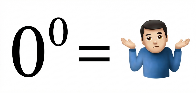
Zero to the power of zero is where mathematics doesn’t give a definite
answer:
Essentially, this
is a formula of perfect order, turning everything into one. You know
everything, the state of every point in the universe; you don't need to
know any other parameters. For every point — except for the very center.
Zero to the power of zero is where mathematics doesn’t give a definite
answer:
The indeterminacy of this expression stems from a fundamental conflict between two algebraic rules. The Rule of Exponents () prescribes that any non-zero number raised to the power of zero equals one. The Rule of Zero Bases () prescribes that zero raised to any non-zero power is zero. When you evaluate the function as both base and exponent simultaneously approach zero and ), the outcome entirely depends on which of the two reaches zero faster:
if the exponent reaches zero faster than the base, the limit goes to one.
if the base shrinks to zero faster than the exponent, the limit goes to zero.
As we approach the Big Bang, that question becomes meaningless, though, because there is no external clock or background metric to measure the race. You cannot ask whether time was moving "faster" than space or vice versa because spacetime itself was potentially emerging. There is no external benchmark available on either time nor space to establish a rate, and no background coordinate system to declare whether spatial dimensions unfolded faster than temporal ones.
Indetermination remains indetermination. It turns out the slightly loose, tilted pin on the cylinder that triggered the chain reaction was sitting right in the middle of the cylinder. That tiny wrinkle, that initial texture irregularity embedded right in the core of the universe, gave birth to reality as we experience it.
Barry and his Hawaiian shirt didn’t crash the party; they were always there. A center of the system needs a symmetrical partner, which essentially would be itself. Barry didn't crash the party. He arrived as his own date, carrying a mirror.
Remember the music box? The comb represents the act of observation, in the present moment, now. But the comb is not moving, even though time passes by; instead, the cylinder and pins are moving underneath it. This is how we perceive reality and time. The act of observation for every observer is also an act of normalization. We compare today to the past, and we evaluate the future from today’s point of view as well. This act of normalization is a choice of measurement. When we normalize we choose the scale. When t=1, time has no impact on the observation:
Every point is shown as it is, no smoothing, no amplification, scale one to one. The moment when the world is seen without distortion. We constantly use the present moment as a normalization adjustment. Any observer may call their “now” one: it is a choice of zero and scale on the axis. You are at t = 1, and so is the observer a billion years from now in a distant galaxy. We do not occupy a special moment. We call special the moment we occupy.
To observe the world is to normalize it to yourself.
The center of the universe
The most common misconception about the Big Bang is imagining it as a bomb going off in an empty room. The Big Bang was not an explosion in space, it was an explosion of space itself. There was no empty void waiting to be filled; most likely the Big Bang was the moment of creation of time and the three spatial dimensions of our universe, and they have been stretching ever since. Because space itself is expanding, every point in the universe is moving away from every other point simultaneously.
To visualize this, physicists often use the balloon analogy. Imagine the surface of a deflated balloon with dots drawn all over it. As the balloon inflates, the rubber stretches. From the perspective of any single dot, all the other dots are moving away from it. The surface of the balloon represents our three-dimensional universe. There is no "center" to be found on the balloon surface. Every dot sees exactly the same expansion happening around it, and no dot is more "central" than another. In the balloon example the center exists, but lies in another dimension, hidden from the dots.
We can also picture this in three dimensions using the raisin bread analogy. Imagine a vat of raisin dough in the oven. As the dough rises, it expands in all directions at the same time. From the point of view of any raisin, you would look around and see every other raisin moving away from you. Moreover, the further away a raisin is, the more expanding dough there is between them, meaning it appears to recede even faster. Now imagine that the dough is endless: there is no crust, there is no outer boundary, it fills everything. Because of that endlessness, no matter which raisin you choose, the expansion looks as though you are at its center. If every point in the universe looks like the center, then the true center is nowhere, or at least not in our three dimensions. This explains why at a large enough scale, the observable universe appears to be isotropic or uniform in every direction.
If the center of the universe is nowhere and everywhere, then the uncertainty of the central point is also everywhere. Barry is not standing in one corner of the room. The original defect of the central element is embedded into every point, because every point is its own center of the universe.
You are a delicious raisin in the middle of the universe.
The nature of risk
The Big Bang event remains a profound mystery. Mathematically the temperature and the density of the Universe at the time of the Big Bang must have been infinitely high, while its spatial dimensions infinitely small. We don’t know how to properly interpret or visualize such conditions, nor how to model them. A soup of particles so hot and dense that our physics stops working.
We can only look at what happened shortly after the Big Bang, not at the Big Bang itself. It remains unattainable; we can only asymptotically approach it. The zero moment in time joins the other ideal states: absolute zero of temperature, 100% efficiency, perfect order. Sharper instruments and better theories will keep improving resolution and precision; they will push the boundary of the unknown further, but never reveal the full truth. The mystery of the universe does not sit behind a locked door; it recedes at exactly the speed we advance; the universe knows how to keep its secrets.
The laws of modern physics compress reality magnificently into a handful of elegant equations developed by Newton, Einstein, Maxwell, Schrödinger — they would fit on a T-shirt. What refuses to compress is the residual gap between model and reality. With every generation, that residual gap gets smaller and smaller and yet it never reaches zero.
The only complete model of the universe might be the universe itself.
Japanese culture has long understood the imperfection of the world around us. When a Zen calligrapher draws the ensō — the circle of enlightenment — the circle is often left slightly open. An almost-circle. The gap is not a mistake; the gap is the point.
The Japanese philosophy of wabi-sabi celebrates the beauty of things being imperfect, impermanent, incomplete. The beauty of things being real. Not beauty despite the flaws — but recognizing beauty because of them.
A broken vase gets a second life when repaired with the kintsugi technique. The shards are carefully put back together and joined with lacquer mixed with gold, so that the initial crack becomes the most precious thing. It is the biography of the vase, documenting and honoring its life, exposing its scars.
Perception studies show it again and again: mild symmetry attracts, but total symmetry repels — perfectly symmetrical faces look lifeless and doll-like. What makes a face alive is a slight skewness: one eyebrow slightly higher, a smile slightly crooked.
Absolute order, absolute safety, absolute perfection: they all represent the same ideal, unreachable states. There is always something left to improve, the chase never ends. A perfect plan, a perfect project, a perfect life partner, perfect relationships exist only in theory as mathematical models. Once you add reality and time to the equation, perfection becomes unreachable. It doesn't exist, not because it is hard to reach, but by definition: the imperfect Universe doesn’t favor things which are fully ordered, symmetric, and ultimately dead.
And hence, closer to home: there is no zero risk. Every gain in resolution reveals structure that was invisible at the old resolution — and with it, new advantages and threats, microscopic and macroscopic alike.
The engine of progress is fueled by constant incremental improvement. We all contribute to it. When doing so, remember that for the universe the change is the being. The path is the goal. Work hard, but don’t chase perfection — it does not exist. You are a rounding error of the primordial war between matter and antimatter, caused by an intrinsic imperfection at the very core of the universe.
Nothing is perfect, nothing lasts forever, nothing is ever finished.
Accept reality, embrace your imperfections, take the risks worth taking. To cross the river you need a bridge. Choose it wisely: not all bridges are equally robust, and all of them eventually collapse. But if you want to get anywhere, you have to step onto one.
To the questions of who Barry is and how he managed to sneak in, physics is still looking for an answer. Barry’s smile is omnipresent: it hangs in the air like the grin of the Cheshire Cat. The vast majority of the primordial matter annihilated — the cat disappeared into thin air — and the tiny fraction that remained is the smile without the cat.